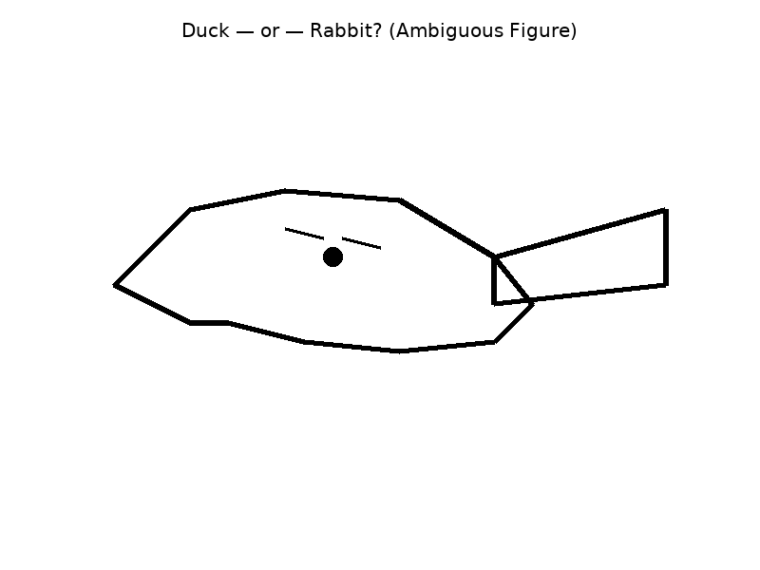
If someone says “I can’t see either / nothing obvious”
What it often means
- The image’s ambiguous cues didn’t resolve quickly into a familiar object for them.
- They may need a hint or different framing.
Psychological facts
- Top-down vs bottom-up processing: Their brain may rely more on top-down knowledge (expectations) and, without a relevant expectation, can fail to resolve the ambiguous lines.
- Vision or attention differences: In rare cases, this could reflect differences in visual acuity, attention, or unfamiliarity with the cultural shapes of ducks and rabbits.
How to help them
- Give a subtle hint: “Look at the right-hand protrusion — do you see a bill or ears?”
- Avoid saying they’re “wrong”; the test is about perception, not intelligence.
If someone gives an unexpected or creative answer (e.g., “a fish,” “a spaceship”)
What it often means
- They’re applying creativity and seeing novel patterns.
- They may prioritize unusual features, metaphoric thinking, or associative leaps.
Psychological facts
- Divergent thinking: Creative and associative thinkers sometimes map ambiguous stimuli to less-common categories.
- Cultural/training effects: Artists or designers might see abstract shapes or structural lines more readily.
How to discuss it
- Celebrate the creativity. This response is as informative as “duck” or “rabbit” — just telling a different story about how they perceive shapes.
What this puzzle doesn’t tell you (important caution)
- It is not a diagnostic test of personality, intelligence, or mental health.
- Any claims like “if you see a rabbit you’re X” are overgeneralizations and not supported by reliable science.
- The puzzle is a conversation starter about perception, priming, and attention — not a psychological profile.
Quick protocol to use this puzzle reliably
- Show the image once (don’t suggest an answer).
- Ask: “What do you see first?” Record the immediate answer (no prompting).
- Ask follow-ups: “Can you also see the other one if you try?” “How long did it take?”
- Note context/priming: Ask if they were thinking of animals or had seen anything related recently.
- Discuss results using the neutral facts above — avoid labels.
Pages: 1 2