If someone answers “Duck”
What it often means
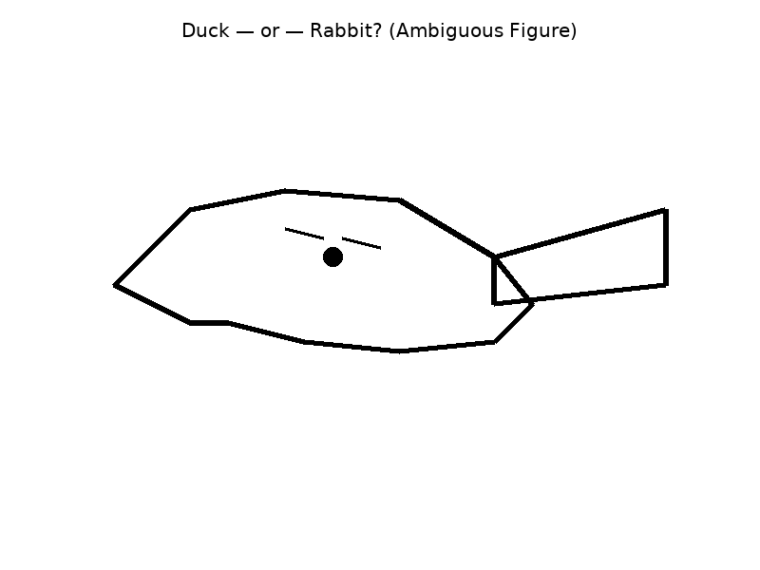
- They focused on the beak-like shape pointing right — interpreted as a duck’s bill.
- They may be responding to context or the first features that catch the eye (long horizontal protrusion).
Psychological facts
- Perceptual set & priming: If the participant recently saw water, birds, or something with a “beak” (or if you casually mentioned “bird”), they become primed to see a duck.
- Local feature attention: People who attend first to salient protrusions (edge/line continuation) tend to pick the duck interpretation.
How to discuss it
- “Seeing a duck first usually means your brain prioritized that protruding shape — neat example of how small cues change perception.”
If someone answers “Rabbit”
What it often means
- They read the protrusion as two ears pointing right; the ‘beak’ becomes ears and the body becomes the rabbit’s head and back.
Psychological facts
- Context effects: If the person has been recently exposed to images or talks about rabbits, or it’s near Easter, rabbit interpretation becomes more likely.
- Gestalt switching: Their brain groups vertical/horizontal lines into ear shapes; they may favor symmetrical features (two “ears” vs. one “beak”).
How to discuss it
- “You saw the ears — cool! This shows how the same lines can form entirely different meaningful shapes depending on what your brain expects.”
If someone says “Both” or “I can switch between them”
What it often means
- They’re capable of perceptual switching — seeing both interpretations and toggling between them.
Psychological facts
- Cognitive flexibility: People who can easily reinterpret ambiguous figures tend to be more mentally flexible in tasks requiring switching perspectives.
- Bistable perception: The image becomes a bistable stimulus: the brain alternates between two stable interpretations because both are plausible given the same visual info.
How to discuss it
- “Nice — you can switch! That’s a sign of strong cognitive flexibility and willingness to consider multiple interpretations.”
If someone says “I can’t see either / nothing obvious”
TO CONTINUE READING THE ARTICLE PLEASE SEE PAGE 2
Pages: 1 2