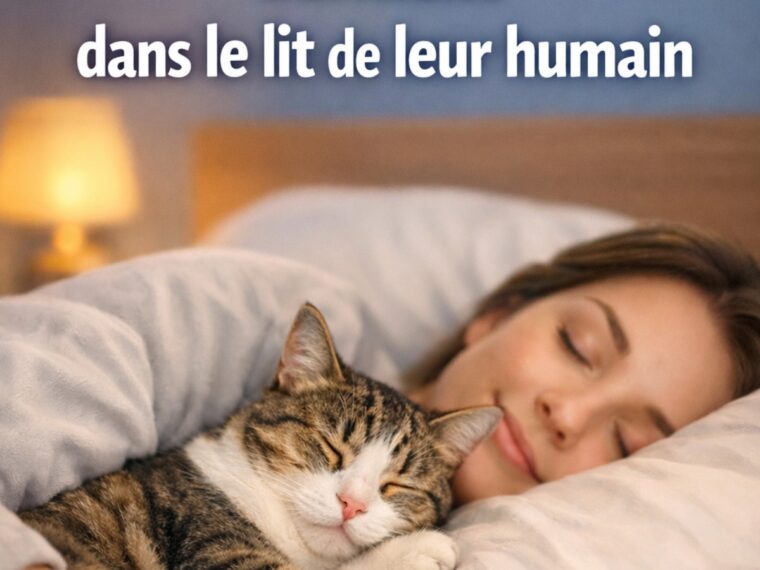
The Science, the Bond, and the Beautiful Meaning Behind It 🐾
If you’ve ever woken up to find your cat curled up beside you—or even sleeping on your chest—you’re not alone. Many cats choose their human’s bed over a cozy cat bed or sofa. But this behavior isn’t random or just about comfort. It’s deeply rooted in biology, instinct, emotional bonding, and trust.
Let’s explore why cats do this, what science says about it, and what it means for your relationship with your feline companion.
🌡️ 1. Warmth: A Natural Magnet for Cats
Cats naturally seek warmth. Their ideal resting temperature is higher than that of humans.
Scientific facts:
- Domestic cats have a preferred temperature range that is warmer than typical room temperature, prompting them to seek warmth sources such as blankets and humans. (Bradshaw et al., 2012)
- Your body’s heat provides an ideal resting temperature, making your bed an attractive sleeping spot.
👉 Your cat isn’t just cozy—it’s physically comfortable!
📌 Reference:
Bradshaw, J., Casey, R., & Brown, S. (2012) The behaviour of the domestic cat. CABI.
🛡️ 2. Safety and Survival Instincts
In the wild, sleep is a vulnerable time for cats. Even domestic cats retain this instinct.
Why your bed feels safe:
- Research shows that cats prefer secure resting places where they can feel protected from threats. (Ellis & Wells, 2010)
- Your presence, breathing, and scent signal comfort and protection.
📌 Reference:
Ellis, S. L. H., & Wells, D. L. (2010) The influence of visual stimulation on the behaviour of cats housed in a rescue shelter. Applied Animal Behaviour Science.
❤️ 3. Bonding and Emotional Attachment
Cats may have a reputation for being independent, but research shows they form strong emotional bonds with their humans.
What science tells us:
- A study published in Current Biology found that cats show attachment behavior toward their owners similar to that of infants with caregivers. (Vitale et al., 2019)
- Being close triggers bonding hormones like oxytocin, promoting mutual trust.
📌 Reference:
Vitale, K.R., Behnke, A.C., & Udell, M.A.R. (2019) Attachment bonds between domestic cats and humans. Current Biology.
🧠 4. Your Scent = Comfort
Cats rely heavily on scent — more than vision or sound — to interpret their world.
- Scent markers are a foundation of feline social behavior. Cats rub and sleep around scents they trust. (Wells & Hepper, 2000)
- Your cat mixing its scent with yours is a sign of acceptance and comfort — an emotional and chemical bond.
📌 Reference:
Wells,D.L. & Hepper,P.G. (2000) Scent-marking in domestic cats (Felis catus): olfactory communication in a social species. Journal of Zoology.
🕰️ 5. Routine and Predictability
Cats have powerful internal clocks and thrive on routine.
Your consistent bedtime schedule becomes a cue for them.
- A study on circadian rhythms in cats shows that routines influence behavior strongly. (Refinetti, 2013)
- Stable sleep patterns provide emotional security.
📌 Reference:
Refinetti, R. (2013) The circadian rhythm of body temperature. Frontiers in Bioscience.